

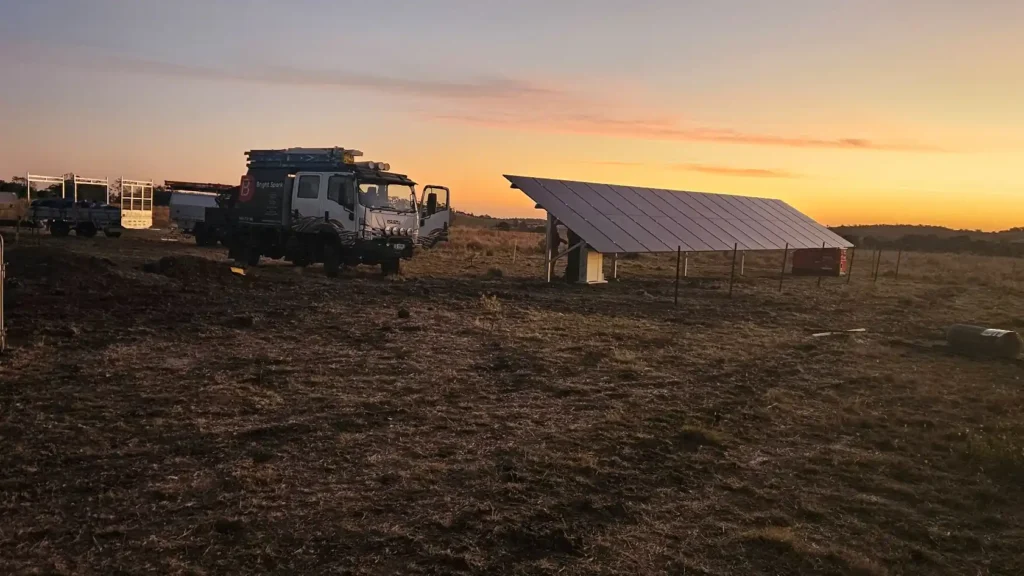
Farm power is different from house power. A farmhouse may have steady evening use, while a working property can have pumps starting at daylight, a cold room cycling all night, welders in the shed and trough pumps after a dry week. That is why off grid solar for farms and rural properties needs to start with load sizing, not a rough panel count.
At Bright Spark Group, we size the system around what the farm actually needs to run. We check motor ratings, start-up surge, daily run hours, battery reserve, generator backup, cable distance and switchboard condition.
Why load sizing matters for off grid solar systems for farms
The biggest mistake is sizing an off grid solar system from the monthly bill alone. Bills can help, but they do not show what happens when a 3-phase pump kicks in while a cool room compressor is starting.
Load sizing breaks the property into real circuits and real jobs. We look at running load, start-up load and daily energy use. Start-up load matters on farms because a pump motor can pull several times its running current for a short burst.
A proper load check should cover:
- Running load once equipment is operating
- Start-up load for pumps, compressors and motors
- Daily use in kilowatt-hours
- Critical loads that must stay on overnight
- Seasonal peaks, such as irrigation or extra cold storage
- Future loads, including new sheds or extra pumps
Sizing irrigation pumps
Irrigation is often the first load we check because pumps can be hard on an off-grid power system. A small transfer pump is one job. A larger bore pump, dam pump or pressure system is another, especially with a long cable run or heavy start.
We want to know the pump size, voltage, phase, control gear, pipe distance, run hours and pressure requirements. If the pump is old, we also check whether the motor is drawing too much current.
Solar power for farms works best when heavy loads can run during daylight. A pump filling header tanks during solar hours may need less battery support than a pump that needs full power at 2 am.
Cold storage needs steady overnight power
Cold rooms, freezers, milk refrigeration and produce storage need dependable power through the night. They may not draw high power every minute, but they cycle harder in Queensland heat.
This is where the off grid solar battery becomes part of the farm’s production protection. We size the battery around overnight demand, safe depth of discharge, backup reserve and recharge time the next day.
A good cold storage check includes the compressor rating, defrost cycle, thermostat settings, insulation, door seals and how often doors open during packing.
Sheds, workshops and machinery loads
Farm sheds are rarely simple. One shed may have LED lighting and battery chargers. Another may have welders, compressors, grinders, hoists, washdown pumps, roller doors and a switchboard that has been added to over the years.
A welder used in short bursts is different from a compressor that starts many times a day.
We also inspect the electrical side. Long submains, old switchboards, undersized cables and loose terminations can create voltage drop and nuisance tripping. Bright Spark Group handles solar and electrical work together, so switchboard upgrades and circuit separation can be planned with the off-grid solar design.
Livestock water and small constant loads
Livestock systems often use smaller loads, but those loads matter because they run daily. Trough pumps, electric fencing, tank level controls, remote monitoring, gate motors, Wi-Fi links and cameras can sit quietly in the background until they fail. Then the farm notices quickly.
These loads are usually good candidates for solar because many are predictable. The trap is forgetting them during sizing. A small pump, a camera system and a few low-voltage controls can take a steady bite out of the battery over 24 hours. On remote paddock setups, cable distance and weatherproof enclosures also matter.
How the battery and inverter are sized
Panels produce the energy. The battery stores it. The inverter has to deliver it at the right moment. All three need to match the farm’s loads.
For battery sizing, we look at daily kilowatt-hour use, overnight load, backup reserve and the number of poor solar days the farm wants to cover. Our solar battery systems work often starts with the same question we ask on farms: what needs power when the sun is not producing?
Do you still need a generator?
Many farm systems should keep a generator in the plan. That does not mean the solar has failed. It means the property has a backup source for long wet periods, unusual production demand or emergency loads. A good hybrid setup can reduce generator run time while keeping it available when the battery reaches a set limit.
Generator integration should be planned, not added with a lead and a guess. We check changeover arrangements, charging settings, earthing, location, ventilation, fuel storage and how the farmer wants the system to behave. Some owners want manual control.
Site conditions can change the design
Two farms with the same loads can need different systems. A shed near Ipswich with clear roof space is not the same as a remote pump site outside Toowoomba with dust, shade, livestock access and a long cable run.
We check panel location, access for maintenance, inverter and battery placement, switchboard condition and the route between generation and load. For external source, the Queensland electrical safety regulator provides guidance on electrical safety duties for solar farm construction and operation, which is useful context for larger solar work and site risk planning.
For external source, the Australian Government solar consumer guidance also explains solar and battery choice and maintenance for homes and businesses.
What we ask before sizing a farm system
A site visit or detailed load review gives the clearest result. Before we quote, these details help us avoid guesswork:
- A list of pumps, motors, cold rooms, shed circuits and farmhouse loads
- Photos of nameplates on pumps, compressors and key equipment
- Current bills, generator fuel use or meter data where available
- Run times for irrigation, refrigeration and workshop equipment
- Any planned upgrades, new sheds or extra stock watering points
- The loads that must keep running during bad weather
From there, we sort loads into critical, heavy, daytime, overnight and occasional use.
Practical sizing beats guesswork
Off grid solar systems for farms should be sized from the property up. Irrigation, cold storage, sheds and livestock loads all behave differently, and the system has to handle those differences without constant resets or flat batteries.
Bright Spark Group designs and installs off-grid solar, batteries and electrical upgrades across Ipswich, Brisbane, South East Queensland and regional Queensland. If you are planning solar for a farm, pump site, shed or rural property, our team can check the loads and give you a practical path before money is spent on the wrong gear. You can contact Bright Spark Group for a farm solar assessment and talk through the property, the loads and the backup you need.
FAQs
The right size depends on the farm’s daily load, peak start-up load, battery reserve and backup needs. Pumps, cold rooms, sheds and livestock systems should be measured separately before the solar array, inverter and battery are selected.
Yes, off grid solar can run many irrigation pumps when the pump size, start-up current and run time are allowed for in the design. Larger pumps may need a bigger inverter or generator backup.
Farm battery storage depends on overnight loads, critical equipment and how many cloudy days the owner wants to cover. Cold storage and stock water usually need more reserve than basic shed lighting.
Solar can reduce diesel run time and fuel handling, especially where daytime loads are high. Diesel may still be useful as backup for long wet periods or large motors.
Yes, many farm systems can be planned for future expansion. Planning early is easier than rebuilding the system later.